 John Lennon Memorials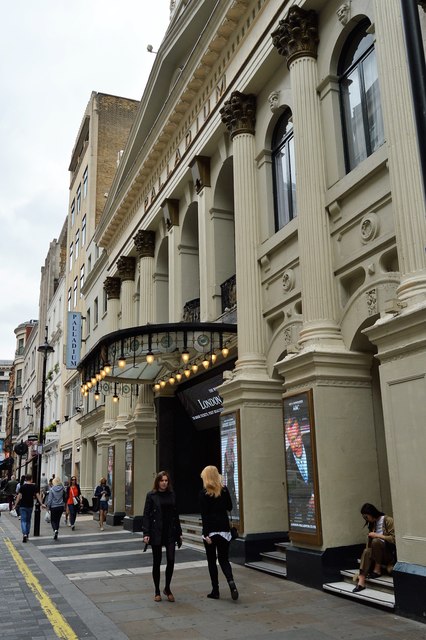
London Palladium, Where the Beatles Played Sunday Night at the London Palladium
The London Palladium on Argyll Street, London, is where the Beatles topped the bill of Sunday Night at the London Palladium on 13 October 1963, the night national press coverage of their fans took off; there is no Beatles marker.
The Beatles topped the bill of Sunday Night at the London Palladium on 13 October 1963, at the Palladium theatre on Argyll Street in London's West End. Fans crowded the street all day, and the next morning's papers were full of it. The theatre is still open for shows, but no plaque marks the Beatles' appearance.
Topping the bill on a Sunday in October 1963
Val Parnell's Sunday Night at the London Palladium was the biggest variety programme on British television, watched by families rather than just teenagers, and on 13 October 1963 the Beatles headlined it. Bruce Forsyth hosted. Brook Benton and Des O'Connor were also on the bill, along with the show's Beat the Clock game.
The group played for about ten minutes. From Me to You, I'll Get You, She Loves You and Twist and Shout are documented, though nobody has pinned down the complete set. Audience estimates differ. Wikipedia gives about 15 million viewers, while the Beatles in London site puts it nearer 18 million. No video recording is known to survive, but audio of the broadcast does, along with news film of the crowds outside.
The crowd on Argyll Street
Fans gathered outside the theatre from early in the day. Newspaper reports described more than a thousand teenagers and a police line of more than 60 officers holding them back. Crowds were waiting at the stage door, so the Beatles went out through the front entrance instead.
Tony Barrow, the Beatles' press officer, later said UK Beatlemania took off after this show. They came back to the programme in January 1964 and played the Night of a Hundred Stars charity show at the Palladium that July.
Who first printed "Beatlemania"?
Many accounts say the Daily Mirror invented the word in its report the next morning. The Mirror did cover the fan scenes, but when Slate searched the archives in 2013 the word itself turned up first in the Daily Mail, in a Vincent Mulchrone piece on 21 October 1963. The Mirror didn't use it until 2 November. That was two days before the Beatles played the Royal Variety Performance at the Prince of Wales Theatre, a different theatre and a different show.
What you can see today
Frank Matcham designed the Palladium, and it opened on 26 December 1910. It is Grade II* listed and still stages West End shows, so you need a ticket to see inside. There is no Beatles plaque on the building. The plaques that are there honour Lew Grade, Frankie Vaughan and, since 2018, Bruce Forsyth, the man who introduced the Beatles that night.
Carnaby Street, with the Imagine statue of John Lennon, is a few minutes' walk away. So are the rooftop concert plaque on Savile Row and Trident Studios in St Anne's Court, where Hey Jude was recorded.
Common misconceptions
-
ClaimThe Daily Mirror coined the word Beatlemania the morning after the Palladium show.
RecordAn archive check found the word first in the Daily Mail on 21 October 1963; the Mirror did not print it until 2 November.
Why the mix-upThe Mirror's coverage of the fan scenes on 14 October is often merged with the later coinage.
-
ClaimThe Beatles' 1963 Royal Variety Performance was held at the London Palladium.
RecordIt was held at the Prince of Wales Theatre on Coventry Street on 4 November 1963.
Why the mix-upBoth were televised London variety shows within three weeks of each other.
Nearby
Sources
- Wikipedia. London Palladium. Accessed 15 September 2026.
- Slate. Beatlemania origin: 50 years ago, the Beatles played London Palladium. Accessed 15 September 2026.
- Beatles in London. The Beatles at the London Palladium, October 13th 1963. Accessed 15 September 2026.
- The Paul McCartney Project. Sunday Night At The London Palladium. Accessed 15 September 2026.
- OpenStreetMap. London Palladium. Accessed 15 September 2026.
Last verified against sources on . Found an error? Send a correction.