 John Lennon Memorials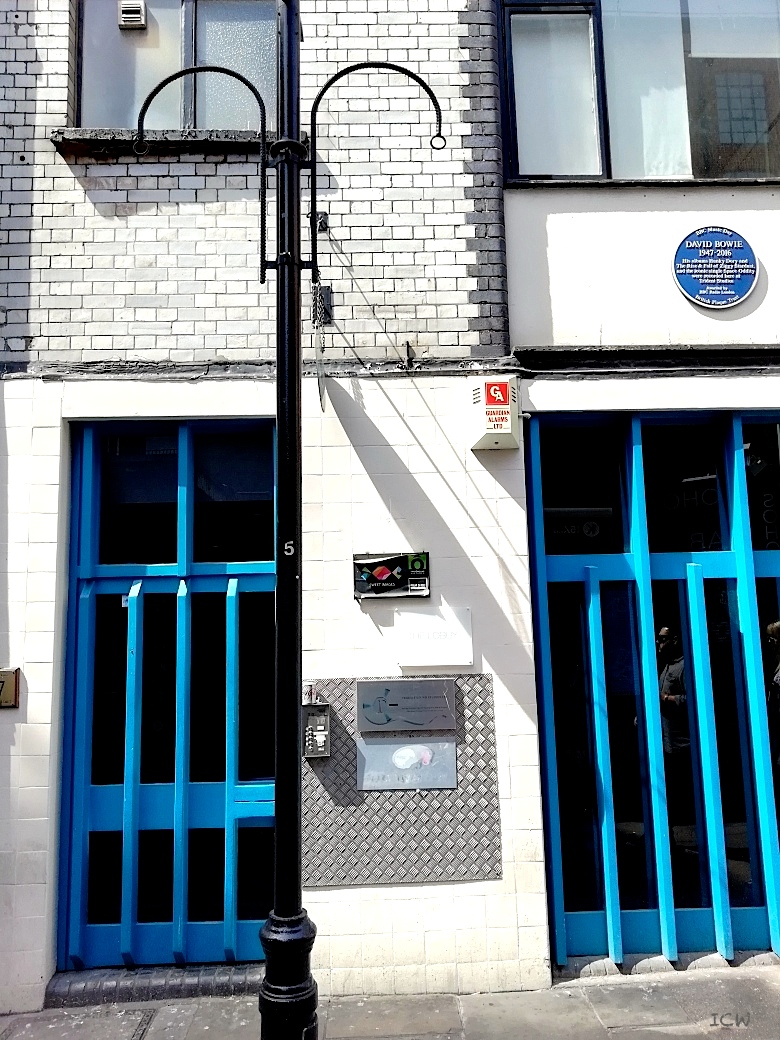
Trident Studios, Soho, Where the Beatles Recorded Hey Jude
Trident Studios at 17 St Anne's Court, Soho, London, is where the Beatles recorded Hey Jude on 31 July and 1 August 1968; the building's only plaque honours David Bowie, and no Beatles marker exists.
The Beatles recorded Hey Jude at Trident Studios, 17 St Anne's Court in Soho, London, on 31 July and 1 August 1968. They left Abbey Road for two days because Trident had an eight-track tape machine. The building still stands but is no longer a studio. Its one plaque is for David Bowie, and nothing marks the Beatles.
Why the Beatles left Abbey Road for two days
Brothers Norman and Barry Sheffield opened Trident in St Anne's Court in 1968. The studio had an eight-track tape recorder at a time when EMI's studios at Abbey Road were still recording on four tracks. More tracks meant more room to build a song up in layers, and the Beatles wanted that for Hey Jude.
They rehearsed the song at Abbey Road Studios on 29 and 30 July 1968, then moved to Trident on 31 July to record it. That session produced four takes, and the first became the master. Paul McCartney played Trident's house piano, a C. Bechstein grand built in 1898, and Barry Sheffield engineered. On 1 August they added overdubs, including a 36-piece orchestra for the long ending. Hey Jude became the first Beatles song recorded on eight-track.
The tapes still had a problem. Played back at EMI they sounded murky, and the engineers had to fix that before the final mixes were done at Abbey Road in early August.
More Beatles work at St Anne's Court
The group came back for several songs that ended up on the White Album, including Dear Prudence, Martha My Dear, Savoy Truffle and Honey Pie. Apple artists used the studio too. McCartney produced Mary Hopkin's Those Were the Days there, and James Taylor recorded his first album for Apple at Trident. After the split, George Harrison worked on All Things Must Pass at Trident, and Ringo Starr recorded It Don't Come Easy there.
The Bowie plaque and what the building is now
The studio at St Anne's Court closed in 1981. The building now holds offices, and one account says a film company uses it for spoken-word recording. Either way, nobody makes music there and visitors can't go in.
The blue plaque on the front was unveiled on 15 June 2017 by Billy Bragg and the artist George Underwood as part of BBC Music Day. It honours David Bowie, who made Hunky Dory and Ziggy Stardust at Trident. The plaque does not mention the Beatles, and there is no other marker for Hey Jude anywhere on the building.
Soho has two more Beatles stops within a short walk: the London Palladium on Argyll Street and the Imagine statue on Carnaby Street.
Common misconceptions
-
ClaimHey Jude was recorded at Abbey Road Studios.
RecordThe Beatles rehearsed it at Abbey Road on 29 and 30 July 1968 but recorded the master at Trident on 31 July and 1 August.
Why the mix-upAlmost all Beatles records were made at Abbey Road, and the song was mixed there.
-
ClaimThe blue plaque at Trident Studios marks the Beatles' sessions.
RecordThe 2017 plaque commemorates David Bowie; nothing on the building mentions the Beatles.
Why the mix-upWalking tours stop at the plaque for both acts.
Nearby
- Imagine, John Lennon statue on Carnaby Street370 m
- London Palladium, Beatles 1963 Sunday Night at the London Palladium410 m
- Prince of Wales Theatre, Beatles 1963 Royal Variety Performance520 m
- Beatles rooftop concert plaque, 3 Savile Row590 m
- Site of the original HMV store plaque, 363 Oxford Street1,000 m
Sources
- Wikipedia. Trident Studios. Accessed 15 September 2026.
- Wikipedia. Hey Jude. Accessed 15 September 2026.
- MusicRadar. The Trident Studios house piano. Accessed 15 September 2026.
- Beatles in London. July 31st 1968: The Beatles record Hey Jude at Trident Studios. Accessed 15 September 2026.
- Music Week. BBC Music Day blue plaque unveiled in honour of David Bowie. Accessed 15 September 2026.
- OpenStreetMap. 17 St Anne's Court. Accessed 15 September 2026.
Last verified against sources on . Found an error? Send a correction.