 John Lennon Memorials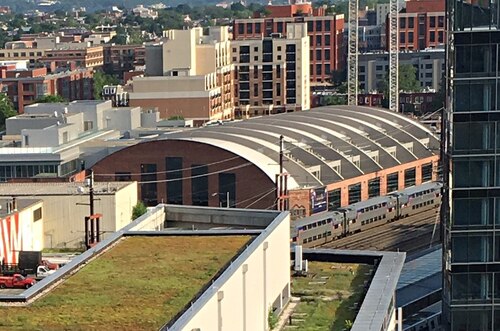
Washington Coliseum, Site of the Beatles' First US Concert
Washington, United States
The Washington Coliseum, the former Uline Arena at 3rd and M Streets NE in Washington, DC, is where the Beatles played their first concert in the United States on 11 February 1964; the building now houses an REI store, with a 1964 sign outside.
The Beatles played their first concert in the United States at the Washington Coliseum, the former Uline Arena at 3rd and M Streets NE in Washington, DC, on 11 February 1964, two days after the Ed Sullivan Show. The barrel-roofed building still stands. Since 2016 it has housed an REI store, and a small 1964 sign outside records the concert.
11 February 1964
The Beatles reached Washington by train. A snowstorm had grounded flights out of New York, so they rode down on the day of the show and arrived at Union Station that afternoon. That evening, less than 48 hours after their Ed Sullivan Show broadcast, they played the Washington Coliseum.
The arena had been built by Michael J. Uline as Uline Arena and was renamed in 1960 by its next owner, Harry G. Lynn. For the concert the stage was a boxing-ring platform in the middle of the floor, so the audience sat on all four sides. Between songs the road manager Mal Evans turned Ringo Starr's drum riser so that a different part of the hall faced the band. Tickets had sold at local record shops for $2, $3 and $4. The snow kept the Chiffons away, and Jay and the Americans took their slot on the bill.
Reported attendance is 8,092, usually rounded to 8,000. Accounts of the set give it as 34 or 35 minutes. Harrison's microphone failed during the opening song, and fans threw jelly beans at the stage for much of the show.
What happened to the building
Concerts continued for two more decades, with acts including Bob Dylan and the city's go-go bands. In May 1971 the arena was used to hold people arrested at protests against the Vietnam War. Live shows ended in 1986, and the building then spent years as a trash-transfer station and later as parking.
The DC Historic Preservation Review Board designated it in November 2006, and it joined the National Register of Historic Places on 17 May 2007. Douglas Development had bought it in 2004. REI opened a 51,000-square-foot flagship store inside on 21 October 2016, with offices added to the site. The concrete barrel roof and trusses were kept, and the store hangs old arena seats and reproduction posters from past events.
What marks the concert today
The marker is modest. On the sidewalk of 3rd Street NE, just south of M Street, a small sign reads "1964 The Beatles" with the line "First Concert in the USA". It is one of a set of year signs outside the building, with others for 1950 and 1953. A larger Cultural Tourism DC panel on the Greater H Street NE Heritage Trail, put up in 2012 at the corner of M and 3rd Streets, also mentioned the concert, but it has since gone missing.
George Harrison had already been in the country the previous autumn, as the First Beatle in America marker in Benton, Illinois records. Seven months after Washington, the band changed planes in Arkansas, remembered by the Abbey Road sculpture in Walnut Ridge.
Inscription
1964 The Beatles First Concert in the USA
Nearby
- Ed Sullivan Theater, site of the Beatles' US television debut, New York City330 km
- Non-Violence (The Knotted Gun), United Nations Headquarters, New York City331 km
- Carnegie Hall, Beatles 1964 concerts, New York City331 km
Sources
- Wikipedia. Uline Arena. Accessed 15 September 2026.
- WTOP News. REI opening DC store where Beatles made history. Accessed 15 September 2026.
- DCist (WAMU). 'Beatlemania' In DC: Remembering The Beatles' First US Concert. Accessed 15 September 2026.
- NBC4 Washington. REI Opening DC Store Where Beatles Made History. Accessed 15 September 2026.
- The Historical Marker Database. The Iceman's Arena Historical Marker. Accessed 15 September 2026.
- The Historical Marker Database. 1964 Historical Marker. Accessed 15 September 2026.
- Ghosts of DC. Beatles' First US Concert: Washington Coliseum, Feb 11, 1964. Accessed 15 September 2026.
Last verified against sources on . Found an error? Send a correction.