 John Lennon Memorials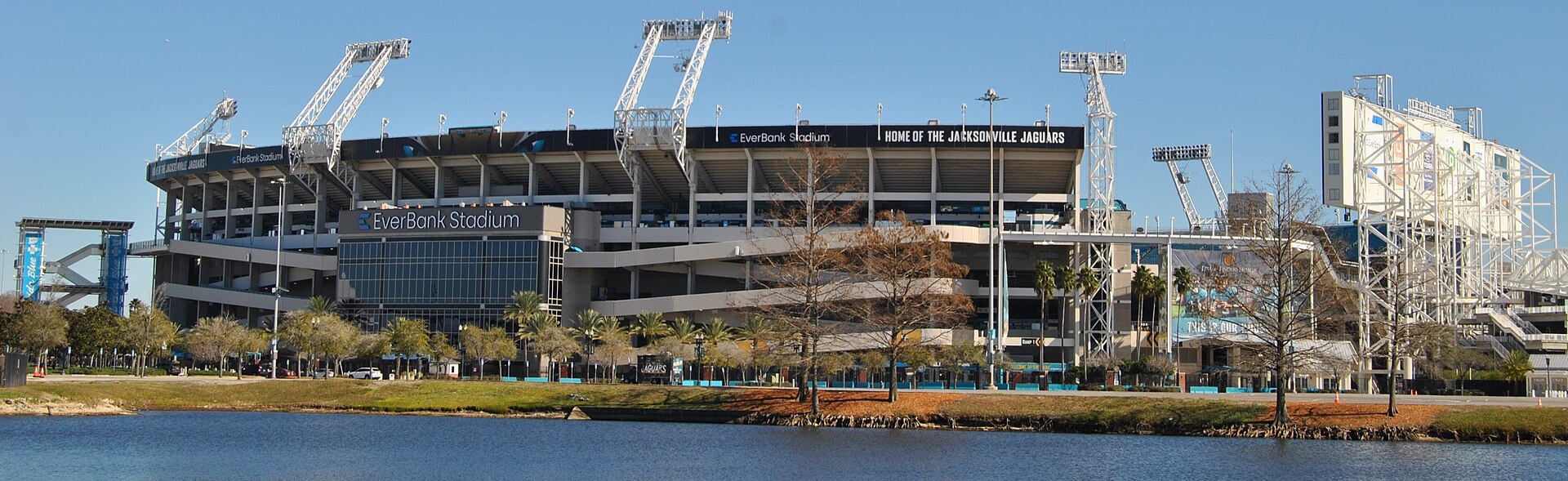
The Beatles at the Gator Bowl, Jacksonville, 1964
Jacksonville, United States
The Gator Bowl in Jacksonville, Florida, rebuilt in 1994-95 and now EverBank Stadium, is where the Beatles played on 11 September 1964 after refusing to perform for a segregated audience.
The Beatles played the Gator Bowl in Jacksonville, Florida, on 11 September 1964, their only concert in the state. Days before, they said they would not go on unless Black fans could sit anywhere, and the show went ahead integrated. The old stadium was replaced in 1994-95 by today's EverBank Stadium, which has no Beatles marker.
The statement before the show
On 6 September 1964, five days before the concert, the Beatles put out a statement that they would not appear unless Black fans were allowed to sit anywhere in the stadium. Lennon added that the band never played to segregated audiences and would rather give up the fee. Two days later, at a press conference in Montreal, he repeated the warning and named Florida.
The Civil Rights Act had been signed on 2 July, but Kitty Oliver, a high-school senior who went to the show, has said daily life in Jacksonville was still segregated. Reports differ on what the stadium intended. Salon and Correcting the Record say the Gator Bowl planned separate seating for Black concertgoers. The Jitney, a Jacksonville history publisher, reports that city officials told reporters segregation had never been planned for the concert. What is not disputed is the outcome: the promoters agreed and the audience was mixed. Florida Humanities calls it the first major integrated concert in the Southeast.
The band's objection went beyond the stadium. In Jacksonville they did not stay at the George Washington Hotel, which barred Black guests.
Hurricane Dora and a windy stage
Hurricane Dora hit the area in the days before the show. The storm diverted the band's flight to Key West, and around Jacksonville it brought down trees and cut power. President Lyndon Johnson was in the city on concert day to look at the damage.
All 32,000 tickets had been sold. About 23,000 people got there; one account says 9,000 ticket holders stayed away, another puts it nearer 7,000. Gusts of up to 45 mph were still crossing the stage, so the roadie Mal Evans nailed Ringo Starr's drums to the floor. Before the Beatles went on, their press officer Derek Taylor insisted that film crews without permission leave. The set ran about half an hour, after support acts including the Exciters, Clarence "Frogman" Henry, the Bill Black Combo and Jackie DeShannon.
The Gator Bowl site today
The stadium the Beatles played no longer exists in its 1964 form. A stadium had stood there since 1927; it was enlarged and renamed Gator Bowl Stadium in 1948. Work on a replacement began on 3 January 1994, and the new stadium opened on 18 August 1995 on the same ground. Only the pedestrian ramps and the West Upper Deck, which was added in 1982, were kept from the old structure. It is now EverBank Stadium, and a $1.4 billion renovation started in February 2025 with completion aimed at the 2028 NFL season.
No plaque or historical marker about the Beatles has been reported at the stadium. The 60th anniversary in 2024 was marked with an evening at the Ritz Theatre and Museum on 12 September, with Kitty Oliver and the author Bob Kealing, rather than with anything on the site.
Seven months before Jacksonville, the band's second Ed Sullivan Show appearance had been broadcast from the Deauville Hotel in Miami Beach, a television appearance rather than a public concert. Two weeks before Jacksonville they played Red Rocks Amphitheatre in Colorado.
Common misconceptions
-
ClaimThe Beatles' contract for the Gator Bowl is the document with the famous 'will not be required to perform before a segregated audience' clause.
RecordThe clause that surfaced and sold at auction in 2011 is in the contract for the 1965 Cow Palace concert in San Francisco. For Jacksonville the documented stand is the band's public statement of 6 September 1964 and Lennon's remarks.
Why the mix-upArticles on the Jacksonville show often illustrate it with the 1965 contract wording.
Nearby
- John Lennon Statue, The Barrymore Hotel, Tampa276 km
Sources
- Florida Humanities. Florida Humanities Celebrates Iconic Beatles 1964 Gator Bowl Concert in Jacksonville. Accessed 15 September 2026.
- Wikipedia. EverBank Stadium. Accessed 15 September 2026.
- Salon. The Beatles in Jacksonville, 1964: Inside the Fab Four's historic stand against segregation. Accessed 15 September 2026.
- Ultimate Classic Rock. When the Beatles Refused to Play Before a Segregated Audience. Accessed 15 September 2026.
- Jacksonville Today. The Beatles integrated their Jacksonville concert 60 years ago this week. Accessed 15 September 2026.
- Correcting the Record. Beatles Take a Stand. Accessed 15 September 2026.
- The Jitney. Sixtieth Anniversary of the Beatles at Jacksonville's Gator Bowl. Accessed 15 September 2026.
Last verified against sources on . Found an error? Send a correction.