 John Lennon Memorials
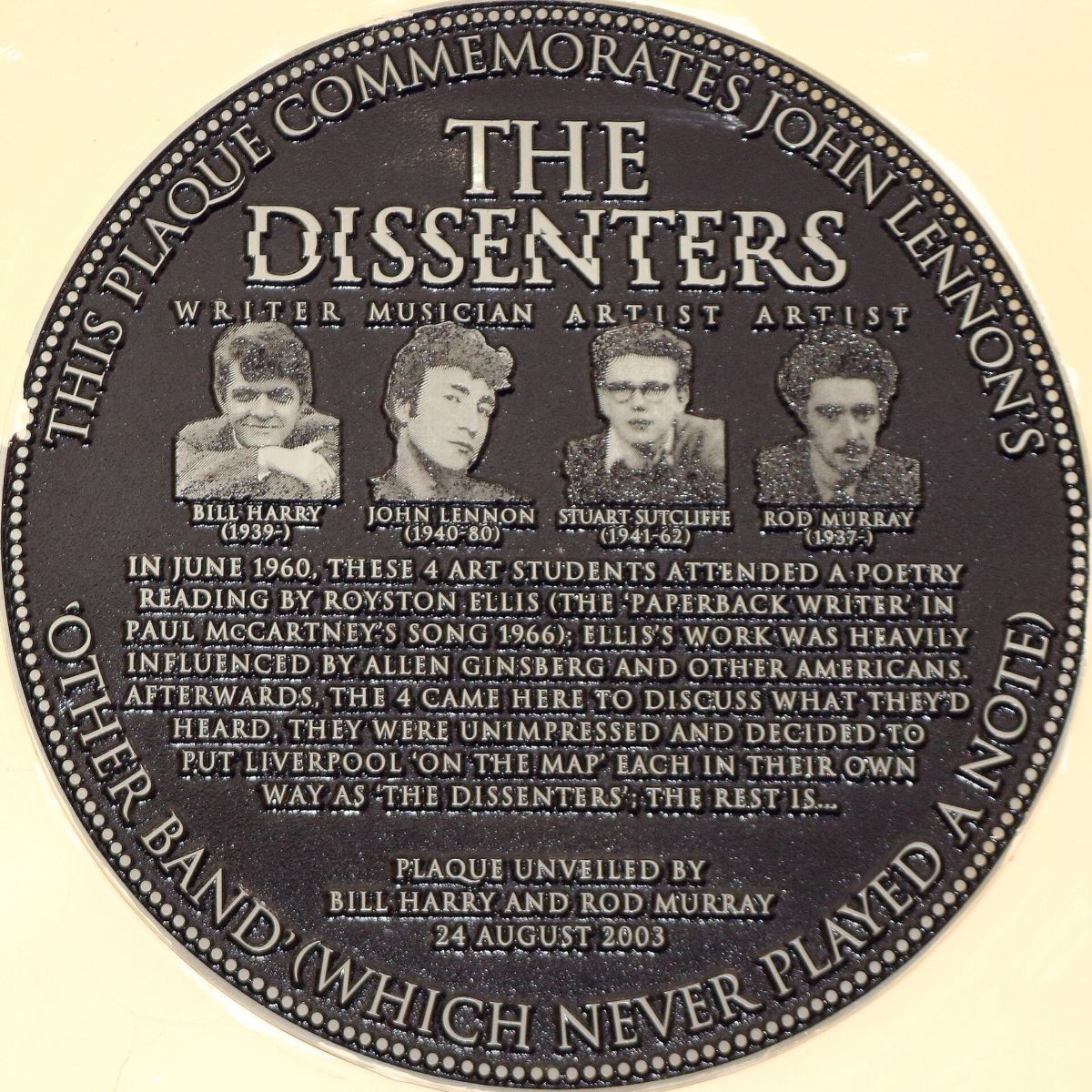
The Dissenters Plaque at Ye Cracke, Liverpool
Liverpool, United Kingdom, 2003
A plaque put up on 24 August 2003 inside Ye Cracke pub on Rice Street, Liverpool, marks the June 1960 meeting where art students John Lennon, Stuart Sutcliffe, Bill Harry and Rod Murray named themselves the Dissenters.
The Dissenters plaque is inside Ye Cracke, a pub at 13 Rice Street off Hope Street in Liverpool. Put up on 24 August 2003, it recalls a night in June 1960 when John Lennon, Stuart Sutcliffe, Bill Harry and Rod Murray, students at the nearby art college, met there and called themselves the Dissenters.
A band that never played
In June 1960 four students from Liverpool College of Art went to hear the poet Royston Ellis read at Liverpool University. Ellis, born in 1941, was younger than any of them, and during the visit he stayed at the Gambier Terrace flat with Lennon and Sutcliffe. Ellis wrote in the manner of the American Beat poets, Allen Ginsberg among them, and the four had been reading that kind of writing themselves. Lennon was the musician of the group, Bill Harry the writer, and Stuart Sutcliffe and Rod Murray were painters. None of them thought much of the reading. Afterwards, over drinks at Ye Cracke, Harry suggested they call themselves the Dissenters, and they agreed that each would make Liverpool known through his own work: Lennon with music, Sutcliffe and Murray with painting, Harry with writing.
Ye Cracke was the obvious place for it. Lennon and Sutcliffe drank there as students at the art college round the corner, and Lennon courted Cynthia Powell there.
Who kept the vow
Harry kept his part fastest. On 6 July 1961, about a year after the night at Ye Cracke, he launched the Mersey Beat newspaper, and its first 5,000 copies sold out. Lennon's part needs no telling. Sutcliffe died in 1962; his grave is at St Michael's Church, Huyton.
Unveiled by the two survivors in 2003
The plaque plays on the story. It calls the Dissenters John Lennon's other band and adds that it never played a note. Harry wrote that he and Rod Murray unveiled it in August 2003; Open Plaques gives the date as 24 August 2003, 43 years after the meeting, and records it as a black plaque. It is the only plaque to the Dissenters.
Don't look for it on the street wall. Photographs taken inside the pub in November 2019 and published on Wikimedia Commons show the original as small, above a doorway between two of the pub's rooms. A larger copy hangs on a wall in another room, and the same text is etched into a mirror.
Common misconceptions
-
ClaimThe Dissenters were a band Lennon played in.
RecordThe Dissenters were four art students, one musician, one writer and two artists, who agreed to put Liverpool on the map through their work; the plaque itself says the 'band' never played a note.
Why the mix-upThe plaque's joke about Lennon's 'other band' is often repeated without the punchline.
Nearby
Sources
- Wikipedia. Ye Cracke. Accessed 15 September 2026.
- Open Plaques. John Lennon, Stuart Sutcliffe, Bill Harry, Rod Murray: The Dissenters plaque. Accessed 15 September 2026.
- Daytrippin' Beatles Magazine. Review: Lennon's Liverpool by Bill Harry. Accessed 15 September 2026.
- CAMRA. Ye Cracke, Liverpool: historic multi-room pub. Accessed 15 September 2026.
- Chrome Dreams (book). Bill Harry, The British Invasion: How the Beatles and Other UK Bands Conquered America (Chrome Dreams, 2004). Accessed 9 October 2026.
- Wikipedia. Bill Harry. Accessed 9 October 2026.
- Wikipedia. Royston Ellis. Accessed 9 October 2026.
- Open Plaques. The Dissenters (1960). Accessed 9 October 2026.
- Open Plaques blog. John Lennon, remembered in plaques. Accessed 15 September 2026.
- Wikimedia Commons. Original Dissenters plaque, Ye Cracke (photos of plaque, copy and mirror, 20 November 2019). Accessed 15 September 2026.
- OpenStreetMap. Ye Cracke, Liverpool. Accessed 15 September 2026.

Last verified against sources on . Found an error? Send a correction.