 John Lennon Memorials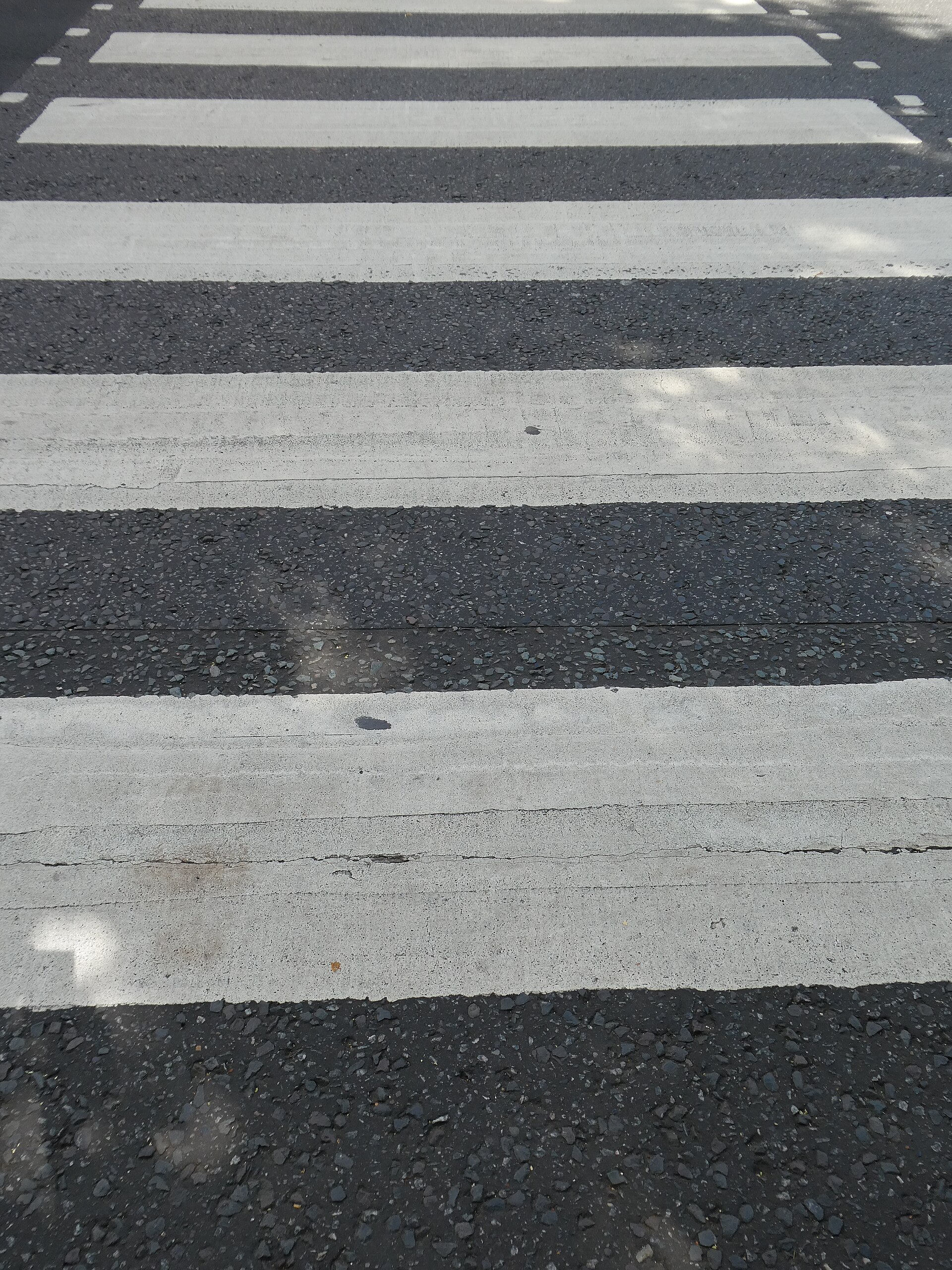
Abbey Road Crossing, London
London, United Kingdom, 2010
The zebra crossing on Abbey Road in St John's Wood, London, where Iain Macmillan photographed the Beatles for the Abbey Road album cover on 8 August 1969, was listed Grade II in December 2010 as the first zebra crossing ever listed.
The Abbey Road crossing is a working zebra crossing on Abbey Road in St John's Wood, north-west London, a few steps south-east of Abbey Road Studios. Iain Macmillan photographed the Beatles walking over it on 8 August 1969 for the cover of Abbey Road. In December 2010 it became the first zebra crossing ever to be listed.
A road marking with Grade II protection
Listing is normally for buildings, so the December 2010 decision was unusual. English Heritage advised the government, and tourism and heritage minister John Penrose announced it on 22 December 2010; the Historic England register dates the listing to the day before. No zebra crossing had been listed before.
The list entry gives two reasons. One is history: this is the crossing from the 1969 album cover, and it is also an example of the road-safety crossing that transport minister Lord Hore-Belisha introduced in 1934. The other is group value with Abbey Road Studios, which had been listed Grade II in February 2010, about 60 m away.
What the listing covers, and what it doesn't
The protected parts are modest: six wide white stripes painted on the Tarmac and two belisha beacons, one at the north-east corner and one at the south-west. The entry is specific about what is excluded. The dashed marks along each side and the zig-zag lines on the approaches were added after 1969 and are "not of special interest". The beacons themselves have plastic globes and aren't the 1930s originals either.
The entry also mentions the graffiti and stickers on the beacon poles, which mirror the messages fans leave on the studio's front wall. The studio repaints that wall every three months. The Abbey Road street sign at the Grove End Road corner was stolen and defaced so often that it now sits higher up on a building.
Has the crossing moved?
This is the question that comes up most, and in 2010 even official voices disagreed. A Westminster City Council spokesperson suggested, from Ordnance Survey maps and old photographs, that the crossing had once been further north near the studio entrance, and a BBC report said it had been moved several metres for traffic management more than 30 years earlier.
Historic England looked at the same question when it wrote the list entry. Its conclusion: comparing the cover photograph, other historic photographs and today's layout shows the crossing is in essentially the same position as in 1969. The Beatles in London guide reaches the same result using fixed reference points, a fire hydrant and a manhole cover, and traces much of the online rumour to an April Fools' edit made to Wikipedia in 2008. The stripes were shifted for a time and later put back.
The ten (or fifteen) minutes in 1969
Macmillan took the photograph on the morning of 8 August 1969, standing on a stepladder while a policeman held back traffic. Penrose's announcement and Wikipedia say he had about ten minutes; the Historic England entry says about fifteen. Either way, the session that made the crossing famous was short.
Visiting the crossing
Take the Jubilee line to St John's Wood. Abbey Road Studios' own directions: cross onto Grove End Road, walk downhill to Abbey Road and turn right, and the crossing is in front of you. Buses 139 and 189 stop outside the studios.
It is a live crossing on a through road, and the list entry notes that groups of tourists are always there waiting to walk it. The studio runs a webcam on the crossing, so you can look yourself up afterwards. The paint wears fast: highways crews repainted the faded stripes on 24 March 2020, when the first lockdown had emptied the street.
The studios themselves are next door; see Abbey Road Studios. The other big London Beatles site, the rooftop of the old Apple building, is about 3.6 km south-east at 3 Savile Row.
Common misconceptions
-
ClaimThe Abbey Road crossing was moved in the 1970s, so today's crossing is not the one on the album cover.
RecordHistoric England's list entry says a comparison of the cover photograph, other historic photographs and the present layout shows the crossing is essentially in the same position as in 1969.
Why the mix-upIn 2010 a Westminster City Council spokesperson and a BBC report said it had been moved several metres for traffic management. One Beatles London guide traces the online spread of the story to a 2008 April Fools' edit of Wikipedia.
Getting there
St John's Wood station (Jubilee line): cross onto Grove End Road, walk downhill to Abbey Road and turn right. Buses 139 and 189 stop outside Abbey Road Studios, per Abbey Road Studios.
Nearby
Sources
- Historic England. Zebra Crossing Near Abbey Road Studios, list entry 1396390. Accessed 13 September 2026.
- DCMS (GOV.UK). 'And in the end...' the Abbey Road zebra crossing is 'listed'. Accessed 13 September 2026.
- Abbey Road Studios. Visit Us. Accessed 13 September 2026.
- British Listed Buildings. Zebra Crossing Near Abbey Road Studios. Accessed 13 September 2026.
- Wikipedia. Abbey Road Studios. Accessed 13 September 2026.
- Wikipedia. Abbey Road (album). Accessed 13 September 2026.
- Wikipedia. Abbey Road, London. Accessed 13 September 2026.
- CNN. London's Abbey Road repainted amid coronavirus lockdown (24 March 2020). Accessed 13 September 2026.
- British Listed Buildings. 3 Savile Row W1 (Historic England list entry 1236103). Accessed 13 September 2026.
- Beatles in London. The Abbey Road Crossing - Has it Moved?. Accessed 13 September 2026.
- OpenStreetMap. Abbey Road Crossing. Accessed 13 September 2026.
- The Beatles Bible. Abbey Road's zebra crossing given Grade II listed status. Accessed 13 September 2026.
- OpenStreetMap. Abbey Road Studios. Accessed 13 September 2026.
Last verified against sources on . Found an error? Send a correction.