 John Lennon Memorials
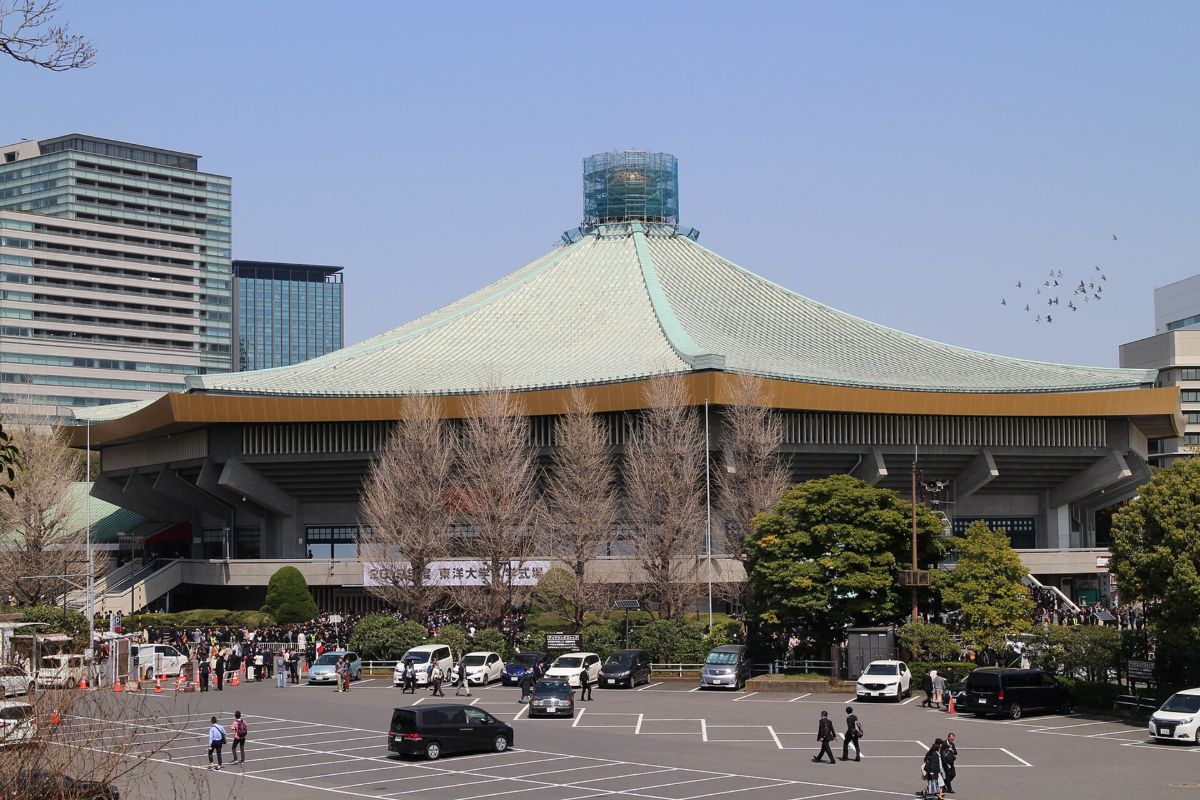
The Beatles at the Nippon Budokan, Tokyo
Tokyo, Japan, 1966
The Nippon Budokan in Tokyo's Kitanomaru Park is the martial arts hall where the Beatles played five concerts, their only shows in Japan, between 30 June and 2 July 1966.
The Beatles played the Nippon Budokan, a martial arts hall in Tokyo's Kitanomaru Park, from 30 June to 2 July 1966. There were five 30-minute concerts, one on the first night and two on each of the next two days. They were the only shows the band ever gave in Japan, and the first rock concerts at the hall.
Why a pop group in this hall caused a row
The Budokan was less than two years old in 1966. Matsutaro Shoriki, the Diet member and founder of Nippon TV, had called for a world-class martial arts hall in central Tokyo in 1961, and it opened on 3 October 1964 for the Olympic judo. It was meant for judo, kendo and the other Japanese martial arts, and every 15 August it holds the national memorial service for the war dead, attended by the Emperor and the Prime Minister.
The choice of hall came down to money. Brian Epstein wanted $100,000 a performance, so the Budokan was chosen, and tickets were set at twice the price of any earlier visiting pop act. To nationalists, a hall reserved for martial arts and tied to the memory of the war dead was no place for four long-haired rock musicians. Right-wing groups drove through the streets in black vans calling for a ban, and ultranationalist students demonstrated in the city and outside the venue. The Beatles also arrived with a written death threat received in Hamburg.
No box office: how fans got tickets
There was no open box office. The sponsors were the Yomiuri Shimbun, Kyodo Kikaku and Chubu-Nippon Broadcasting, and fans had three ways in. They could send a postcard to the Yomiuri, enter prize competitions run by sponsors such as Lion toothpaste and Toshiba Musical Industries, which distributed the Beatles' records in Japan, or buy a return flight on Japan Airlines, which entered them in a ticket lottery. Hoshika Rumiko, then editor of Music Life magazine, recalled young women trying all three at once. Seats cost 2,100, 1,800 or 1,500 yen.
Police in the aisles, nobody on the floor
The security effort was compared with the 1964 Olympics. Accounts of its size differ: Nippon.com counts about 1,700 regular and riot police, while the tour history on Wikipedia says about 35,000 police and fire personnel were mobilised. When the band stepped off the plane at Haneda in Japan Airlines happi coats, about twenty members of the public saw it; fans had been organised into groups along the road into the city. The band stayed in the Presidential Suite of the Tokyo Hilton and left it only for the concerts and one press conference, at which Lennon spoke against the Vietnam War, the first time the group had done so at a press conference. A planned trip to Kamakura on 30 June was called off because police could not guarantee their safety.
Inside the hall the stage stood on a podium about 2.4 metres high. The whole ground floor was cleared, so the audience sat only in the first and second tiers, and concertgoers were told that standing up or cheering could get them arrested. Tony Barrow said the police feared snipers among the right-wing students. Local acts opened, among them the Drifters, Yuya Uchida and the Blue Comets. The Beatles played badly on 30 June and, by Barrow's and Neil Aspinall's account, were shaken enough to tighten up for the remaining shows.
The shows on film
Nippon TV, Shoriki's channel, filmed the 30 June concert, with the band in dark green suits and red shirts, and the first 1 July show, in grey suits with thin orange stripes designed by Hung On You. It edited the footage quickly and broadcast The Beatles Recital: From Nippon Budokan, Tokyo at 9pm on 1 July. The first-night film was later issued by Apple in Japan only, as Beatles Concert at Budokan 1966, and Anthology 2 uses that show's "Rock and Roll Music" and "She's A Woman". On 3 July the band flew out to Manila, where trouble followed at the Rizal Memorial Stadium.
The hall now
The Budokan is a 42-metre octagonal building in Kitanomaru Park, two minutes on foot from Kudanshita Station on the Tozai, Hanzomon and Toei Shinjuku lines. It has no Beatles plaque, and the interior is open only to ticket holders for events. It was renovated in 2020 and held the judo and karate of the Tokyo 2020 Olympics. Hoshika wrote that after 1966 it became routine for major bands to play there. The floor that police kept empty in 1966 now has 2,946 seats of the hall's 14,471 places.
Getting there
Kudanshita Station (Tokyo Metro Tozai and Hanzomon lines, Toei Shinjuku Line) is about two minutes' walk from the Budokan.
Nearby
- John Lennon Museum, Saitama Super Arena (closed), Saitama24.8 km
- Mampei Hotel, Karuizawa, Karuizawa124 km
Sources
- The Beatles (official site). Beatles At The Budokan. Accessed 15 September 2026.
- Wikipedia. Nippon Budokan. Accessed 15 September 2026.
- Wikipedia. The Beatles' 1966 tour of Germany, Japan and the Philippines. Accessed 15 September 2026.
- Nippon.com. The Fab Four in the Far East: The Beatles' 1966 Tokyo Tour. Accessed 15 September 2026.
- Nippon.com. When Beatlemania Came to Japan (Hoshika Rumiko, Music Life editor, 28 Jul 2016). Accessed 9 October 2026.
- OpenStreetMap. Nippon Budokan. Accessed 15 September 2026.
- Internet Archive. Beatles Budokan Tokyo Japan 1966 Nippon TV. Accessed 15 September 2026.
Last verified against sources on . Found an error? Send a correction.